Showing posts with label literature. Show all posts

Wednesday, February 11, 2009

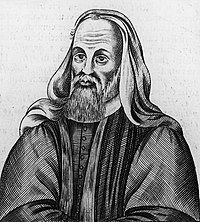
The Song of the Pelagian Heresy by Belloc


Well, I am in my fifteen minute break period between Latin and Christian Doctrine Classes, so I haven't time to be original. So I present to you a song by a far better writer than I.

THE SONG OF THE PELAGIAN HERESY FOR THE STRENGTHENING OF MEN'S BACKS AND THE VERY ROBUST OUT-THRUSTING OF DOUBTFUL DOCTRINE AND THE UNCERTAIN INTELLECTUALby Hilaire Belloc

Pelagius lived in Kardanoel
and taught a doctrine there
How whether you went to Heaven or Hell,
It was your own affair.
How, whether you found eternal joy
Or sank forever to burn,
It had nothing to do with the church, my boy,
But it was your own concern.

(Semi-chorus)
Oh, he didn't believe in Adam and Eve,
He put no faith therein!
His doubts began with the fall of man,
And he laughed at original sin!

(Chorus)
With my row-ti-tow, ti-oodly-ow,
He laughed at orignal sin!

Whereat the Bishop of old Auxerre
(Germanus was his name)
He tore great handfuls out of his hair,
And he called Pelagius Shame:
And then with his stout Episcopal staff
So thoroughly whacked and banged
The heretics all, both short and tall,
They rather had been hanged.

Oh, he thwacked them hard, and he banged them long
Upon each and all occasions,
Till they bellowed in chorus, loud and strong
Their orthodox persuasions!

With my row-ti-tow, ti-oodly-ow,
Their orthodox persuasions!

Now the Faith is old
and the Devil is bold
Exceedingly bold. indeed;
And the masses of doubt
That are floating about
Would smother a mortal creed.
But we that sit in sturdy youth,
And still can drink strong ale,
Oh -- let us put it away to infallible truth,
Which always shall prevail!

And thank the Lord
For the temporal sword,
And for howling heretics, too;
And whatever good things
our Christendom brings,
But especially the barley-brew!

With my row-ti-tow, ti-oodly-ow
Especially the barley-brew!

Tuesday, February 10, 2009

Condensed Books (and Movies)

The idea of condensed books is stolen from RinkWorks, a website that Lady Clare showed me. Under their book-a-minute page, the webster is greeted by the words,

We at Book-A-Minute understand that your time is valuable. You want to experience the wonder and excitement of the fine art of literature, but reading actual books requires a significant time investment. We've got the solution for you. Our ultra-condensed books are just the ticket.

E.g. THE COMPLETE WORKS OF JANE AUSTEN

Female Lead:
I secretly love Male Lead. He must never know.
Male Lead
I secretly love Female Lead. She must never know.
(They find out.)

THE END

So, without further ado - my condensed books and movies.

LES MISERABLES
By Victor Hugo

Javert: I tell you he's alive!
Police: Yeah, right.
Javert: Yet I will find him.
He finds him. Valjean gets away.
Javert: I tell you he's alive!
Police: Yeah, right.
Javert: Yet I will find him.
He finds him. Valjean gets away.

Repeat the above as often as necessary. In the meantime, a revolution occurs, and everyone shoots, gets shot at, falls in love, and come to profound realiztions in sentences that last a page.
Javert: I'm alive! (thinks a moment) Yeah, right. (splash)
Valjean gets away one last time, and more than a cenutry later Boublil and Schonberg are rolling in cash.

THE SCARLET PIMPERNEL
by Baroness Orczy

Marguerite: He's doomed!
Chauvelin: I'm damned.
Percy: I'm demmed! I'm deemed dumb. Dum de dum dum dum. But not really.

THE ELIXIR OF LOVE
By Gaetano Donizetti

He got drunk once and she didn't want him. Then he got drunk again and she did.

THE COMPLETE CANON OF RUSSIAN LITERATURE

Women: (Scream)
Men: I am severely depressed and going through a crisis. I'd better kill somebody or become extremely spiritual in an odd way.
Women: (Scream!)
Men: I have insomnia, I am drunk, I am penniless, and the world holds no meaning for me.
Women: (Scream!)
Men: I think I will go to Siberia/America.
Women: (Scream!) It can't be!
Men: Shut up. I love you, and I can't stand you. Pass the vodka. The world is beautiful. I am very happy.
Women: (Scream!)
Men: Be quiet. I love everything passionately. I hate everything passionately.
All together: (Scream!)

THE COMPLETE WORKS OF ROSSINI

Lovers: Let us go away and marry! We must hurry! Yes, yes, we are going to leave the room. Yes, yes, we will go very silently. Yes, we must leave at once. We cannot dilly-dally. Yes, let us go immediately. Let us set off at once. We have no time to lose. Let us leave, let us hurry. Yes, let us get started.
Guardian: What are you two doing together? Off to a convent with you, my dear!
Lovers: Oh, my head is reeling! Pardon us - love was the cause of everything.
Guardian: Well, in that case I forgive you, and give my consent.
Lovers: Hooray! Long live love! Long live love!

I have many more, but that is enoguh for now.

Magic in Novels, Part II


All right, in my last post I had posed the question of the proper use of magic in fiction, and had established that magic is always wrong in the real world, since, as the Cathechism says, all real magic stems ultimately from Satan. I then asked whether it was permissable to portray magic in a good light in the world of imagination.

Magic has been a traditional part of storytelling for ages, from Gilgamesh consulting the oracle to Sindbad's encounter with the flowers of sorcery to Rumpelstiltskin spinning gold out of straw to a young girl stepping through a wardrobe into another world altogether. I have yet to run across anyone who genuinely believed that it is wrong to read "Sleeping Beauty" because the Lilac Fairy causes everyone to fall asleep by magic. But why not? Why does virtualy every Christian family introduce their children to fairytales when they contain the magic, which is condemned by the Church?
Why? Because fictional magic, properly portrayed, is not the occult. Rather, it is a reflection of the truth in a new, astonishing way. Take, for example, the Disney film of Sleeping Beauty. When Prince Philip is released from Maleficent's dungeons with the help of the fairies' wands, and manages to slay her in her dragon form with the Sword of Truth, it does not mean that he has turned to the power of the devil to acheive what he wants. Rather, this magic is in line with the miraculous power of goodness, and ultimately of God, that frees one from the prison of sin and allows us to triumph against evil, even if it be in the face of impossible odds. it is not a matter of an evil means acheiving a good end. It is a portryal of the truth in a fanciful manner.
Magic is used properly when it properly manifests reality and the natural order. This does not mean things must be portrayed exactly as they are, but in a manner that reminds us of what they truly are. Chesterton can express it in much better language than I can, so I quote from Chapter of 4 of Orthodoxy, "The Ethics of Elfland": "These tales say that apples were golden only to refresh the forgotten moment when we found that they were green. They make rivers run with wine only to make us remember, for one wild moment, that they run with water." It is just so with any manner of fictional magic. It is a literary device to show something astonishing and wonderful happening in a manner that could not be accomplished in day-to-day life, but resounds with truth.

Thus, if Pinnochio can magically transform from a puppet into a real boy, it is because the astonishing change emphasizes the love between him and his father, not dabbling in forbidden arts. The very thought is absurd. If Cinderella is able to don a beautiful gown that appears from no where, it is because she is beautiful in her interior humility. If Bastain can cross over from our world into the realm of Fantastica, it is because we are able to step into a whole new world by imagination and a good book. Granted, good magic is not usually directly allegorical (and it shouldn't be. Blatant symbolism can get on nerves as much as anybody's), but at its heart, it reflects the way things really are. Even "Guide my sword" is a faint affirmation of the power of prayer (Don't tell me I have to tell you what that's from. No, I didn't think so).

So why the great fluster about the appropriateness of imaginary magic? I would say it is because, for the first time in history, fictional magic is seldom used in accordance with the truth. In modern 'witchcraft and wizardry' fiction, magic is used more to violate the natural order than to enhance and glorify it.

Again. I'm just arriving at the beginning of an important point, and I need to go. Yes, I know I could just save it, finsih the post later and publish it to the web... But then again, people are more likely to read shorter blog items! Ha!

Magic in Novels, Part I


All right, this is a controversial topic, but what have I to lose by opening it? After all,

#1. Opening controversial topics has always been one of my favourite pasttimes - the fruit of a Socratic education.

#2. I doubt anyone will even notice I have posted this, seeing as I post so infrequently that it's hardly worth checking in. But what on Earth matters it? My "sister" Lady Rose introduced me to the delightful concept of blogging without obligation. I digress...

#3. It will help me clarify my own ideas as to how I use magic in my current novel.

Yes, as usual, there's a novel running rampant on the green. I am supposedly the master holding the leash, but what can you do when the dashed thing takes a mind to frolic? All you can do is keep a firm hold on the tether, try desperately to keep up with it, and enjoy the ride (or run - this is no pleasure cruise. Exhilarating, yes, but requiring effort)

I don't want to give it away at present - this is the Internet, after all - but suffice it to say that this story takes place in contemporary times, involves Arthurian Lengends (yes, Tennyson is included. One character is a descendant of Dagonet from the Idyllis), and, to get to the pint, magic is involved.

Yes, theren is an overabundance of 'magical' stories on the market. Just walk into the fiction section of Chapters, whether adult or children's, and you'll see shelf after shelf of enchantments, wizardry, and supernatural adventures. (Sorry to all you Americans - I'm assuming Barnes and Noble is similarly stocked. That is the American equivalent of Chapters, isn't it?) The problem is that most of these tales fall under three catergories. Ha, another group of three.

#1. Tolkien ripoffs. You know them. Dark lords, madeup tongues, elves, the quest to destroy the supremely evil thing, and not told in a fresh, new manner, mind you, but simply poor imitations of Tolkien's mastercraft. Yes, Tolkien was a genius, but the hordes of books that really want to be LOTR and aren't are simply pitiful.

#2. Pottermania. Again, another book phenomonon that everyone wants to imitate. (And I truly can't see why - no offence to any of you who are Rowling fans. We must disagree) Kids books these days are full of orphan children and the like learning all about wizardry in the modern world. Ugh. They almost completely dominate the children's sections. Most of these imitations are poorly written, crass, and as far as I can see are a great deal of garbage.

#3. Pink, fluffy stories. Little pixies in sparkly mini-dresses. A girl and her unicorn (a subset of the immense "a girl and her horse" genre). Nothing terrible about them, but they are so - shallow. Theyb do not live up to the name of true fantasy at all. Mainly, they seem to be about rainbows, clouds, follow your dreams, and blah blah blah.

I know I sound pessimistic, but I find it exceeding irritating. Do not get me wrong - I love fantasy. Perhaps that is why I find it so annoying that there aren't more stories like my all-time favourite magical stories - tales like those of Tolkien, C.S. Lewis, Michael Ende, the traditional fairy and folk tales.

All right, I'm getting rather off topic - this is supposed to apply to the use of magic in fiction specifically, and how it will affect my novel. I'd like to say that I love magic in fiction- I think it's wonderful when used well. But what does it mean to use magic well?

Obviously it is always wrong to use magic in real life. There was quite a bit on this in my Christian Doctrine class this morning, and we went over the Cathechism's words on magic. CCC #2116-2117 states:


All forms of divination are to be rejected: recourse to Satan or demons, conjuring up the dead or other practices falsely supposed to "unveil" the future. [Cf. Deut 18:10; Jer 29:8] Consulting horoscopes, astrology, palm reading, interpretation of omens and lots, the phenomena of clairvoyance, and recourse to mediums all conceal a desire for power over time, history, and, in the last analysis, other human beings, as well as a wish to conciliate hidden powers. They contradict the honor, respect, and loving fear that we owe to God alone.
All practices of magic or sorcery, by which one attempts to tame occult powers, so as to place them at one's service and have a supernatural power over others - even if this were for the sake of restoring their health - are gravely contrary to the virtue of religion. These practices are even more to be condemned when accompanied by the intention of harming someone, or when they have recourse to the intervention of demons. Wearing charms is also reprehensible. Spiritism often implies divination or magical practices; the Church for her part warns the faithful against it. Recourse to so-called traditional cures does not justify either the invocation of evil powers or the exploitation of another's credulity.


But what about in the world of books? Is it wrong to read or write about the "good guys" using magic? You obviously can tell that I don't think so, having already stated some of my favourite fantasy authors, who do portray some magic used judicially (although Tolkien is definitely not so magical as some believe him to be. Gandalf may be a wizard, but he sure doesn't recourse to non-natural means of achieving good very often).

I need to attend Mass now. At any rate, I have posed the question. I'll continue later.
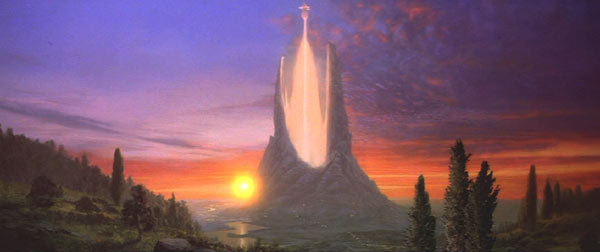
Oh, and the picture at the top is from The Neverending Story. You have read it, haven't you?

Wednesday, December 24, 2008

Random Thoughts on Christmas Eve

Good day, my dear friends. I am, without warning, in a mood for blogging today. I have truly no idea what I am to write, but hopefully something of at leat a little merit will arise.

Well, let's see. Over the last few days I indulged in my taste for film in a very small way by piecing together a mock trailer for a non-existant film of Jane Austen's "Mansfield Park". I read the book this past year, and despite numerous warnings that I would not enjoy this 'black sheep' of the Austen canon to any great degree, I was happily surprised to find that I did, especially since I also read the "scandalous" play they nearly perform in it, "Lovers' Vows" (please don't be shocked - it's milder than some of the things Jane Austen puts in her books, and is an extremely moral story about extremely proper people. I can't help but think JA was poking a bit of fun at Fanny and Edmund by having them so upset by it). However, I have yet to see any of the three film adpations, having been warned by the other ladies (and a few gentlemen!) of the Republic of Pemberley that two of the three versions are rather unfaithful to the book (Slavery? A vivacious Fanny Price? Fanny actually accepting - ugh - Henry Crawford?). The remainging one, an old BBC production, is rather hard to find. I suppose I could look on Amazon... Yes... But, in any case, I have not seen any film of MP. For this reason, I decided to cast some actors from films in my own selection of DVDs as Austen's characters, and edit them into a trailer. Heavily relying on films like "Rossini's Ghost" and "Persuasion", with about six films in all, and using music from Leonardo de Fillipis' "Therese", I'm rather pleased with the end product. Unfortunately, I can't post it for copyright reasons, but I certainly enjoyed it.


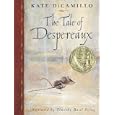
Well, The Tale of Despereaux film has been released, I believe. I don't know how it's doing in box offices, and I don't care at all. Ordinarily I am not a purist, and enjoy a film adaption of a book as much as any other, but somehow Kate DiCamillo's wonderful book, which everyone ought to read, is not compatible with 3D, CGI animation. No. Please read the book - a perfectly crafted story, nominally for children, but truly a piece of art for anyone. I believe C.S. Lewis said something to the effect that a children's book that cannot be read with enjoyment and profit by adults is a bad children's book. This is certainly not a bad children's book. Please, treat yourself to the beauty of this tale of darkness, light, a mouse, a princess, a needle, and a bowl of soup.

But not in the cinema.

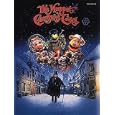
Last night was our family's annual viewing of "The Muppet Christmas Carol". Sometime this evening we will likely have our annual viewing of the Alistair Sims "A Christmas Carol" (Yes, I have read the book many times). Since the Muppet version is still fresh in my mind, I might as well dash off a bit about that as well. I must say that while it is definitely not the Dickens story, it is certainly an enjoyable romp. Michael Caine as Scrooge is fair. Gonzo and Rizzo, in their first time cast together, are just as delightful as they are in "Muppet Treasure Island". Our family loves Scrooge's nephew, Fred, dearly, and this Fred tops those of every serious adaption of the classic. He just exudes joy and makes you smile. Some songs are rather forgettable - for instance, "Bless Us All" - but some I can't help but enjoy. I especially like "There Goes Mr. Scrooge", with it's wonderful opening in a minor key, and the darkening of the streets as Scrooge traverses London, and the Ghost of Christmas Present's jolly "It Feels Like Christmas" - I think it's the people in wonderful 1830's fashions dancing around teh square that does it. Speaking of fashions, this adaption actually follows them very well during the "Christmas Past" sequence. For instance, When Scrooge is a young boy, we see tricorn hats, knee-breeches, and ruffles abounding - very 1780's. By the time of 'Fozzywig's' Christmas Party, Fozzy certainly is wearing a wig very much in keeping with the 1790's, and Belle's gown reminds me of Marguerite's in "The Scarlet Pimpernel". Some years later, when Scrooge and Belle go their seperate ways, any Jane Austen fan can describe their regency fashions without even seeing the film. And then, of course, the wonderful corkscrew curls and toppers of the 1830's present. Marvelous!

Well, I really ought to make myself useful about the house - and I'm afraid I've a few gifts to wrap. Good heavens, everything I've written has been related in some manner or other to film! How embarassing. At any rate, Happy Advent! Hopefully I'll be here to wish you all a merry Christmas on the morrow.

Thursday, June 19, 2008

Major Technological Breakthrough!

Introducing the new Bio-Optic Organized Knowledge device, trade named: BOOK.

BOOK is a revolutionary breakthrough in technology: no wires, no electric circuits, no batteries, nothing to be connected or switched on. It's so easy to use, even a child can operate it.Compact and portable, it can be used anywhere -- even sitting in an armchair by the fire -- yet it is powerful enough to hold as much information as a CD-ROM disc.

Here's how it works:BOOK is constructed of sequentially numbered sheets of paper (recyclable), each capable of holding thousands of bits ofinformation. The pages are locked together with a custom-fit device called a binder, which keeps the sheets in their correct sequence. Opaque Paper Technology (OPT) allows manufacturers to use both sides of the sheet, doubling the information density and cutting costs. Experts are divided on the prospects forfurther increases in information density; for now, BOOKs with more information simply use more pages.

Each sheet is scanned optically, registering information directly into your brain. A flick of the finger takes you to the next sheet. BOOK may be taken up at any time and usedmerely by opening it.Unlike other display devices, BOOK never crashes or requires rebooting, and it can even be dropped on the floor or stepped on without damage. However, it can become unusable if immersed in water for a significant period of time. The "browse" feature allows you to move instantly to any sheet and move forward or backward as you wish. Many come with an "index" feature, which pinpoints the exact location of selected information for instant retrieval.

An optional "BOOKmark" accessory allows you to open BOOK to the exact place you left it in a previous session -- even if the BOOK has been closed. BOOKmarks fit universal design standards; thus, a single BOOKmark can be used in BOOKs by various manufacturers. Conversely, numerous BOOKmarkers canbe used in a single BOOK if the user wants to store numerous views at once. The number is limited only by the number ofpages in the BOOK.You can also make personal notes next to BOOK text entries with an optional programming tool, the Portable Erasable Nib Cryptic Intercommunication Language Stylus (PENCILS).

Portable, durable, and affordable, BOOK is being hailed as a precursor of a new entertainment wave. Also, BOOK's appeal seems so certain that thousands of content creators have committed to the platform and investors are reportedly flocking. Look for a flood of new titles soon.

- Anonymous