


All right, this is a controversial topic, but what have I to lose by opening it? After all,
#1. Opening controversial topics has always been one of my favourite pasttimes - the fruit of a Socratic education.
#2. I doubt anyone will even notice I have posted this, seeing as I post so infrequently that it's hardly worth checking in. But what on Earth matters it? My "sister" Lady Rose introduced me to the delightful concept of blogging without obligation. I digress...
#3. It will help me clarify my own ideas as to how I use magic in my current novel.
Yes, as usual, there's a novel running rampant on the green. I am supposedly the master holding the leash, but what can you do when the dashed thing takes a mind to frolic? All you can do is keep a firm hold on the tether, try desperately to keep up with it, and enjoy the ride (or run - this is no pleasure cruise. Exhilarating, yes, but requiring effort)
I don't want to give it away at present - this is the Internet, after all - but suffice it to say that this story takes place in contemporary times, involves Arthurian Lengends (yes, Tennyson is included. One character is a descendant of Dagonet from the Idyllis), and, to get to the pint, magic is involved.
Yes, theren is an overabundance of 'magical' stories on the market. Just walk into the fiction section of Chapters, whether adult or children's, and you'll see shelf after shelf of enchantments, wizardry, and supernatural adventures. (Sorry to all you Americans - I'm assuming Barnes and Noble is similarly stocked. That is the American equivalent of Chapters, isn't it?) The problem is that most of these tales fall under three catergories. Ha, another group of three.
#1. Tolkien ripoffs. You know them. Dark lords, madeup tongues, elves, the quest to destroy the supremely evil thing, and not told in a fresh, new manner, mind you, but simply poor imitations of Tolkien's mastercraft. Yes, Tolkien was a genius, but the hordes of books that really want to be LOTR and aren't are simply pitiful.
#2. Pottermania. Again, another book phenomonon that everyone wants to imitate. (And I truly can't see why - no offence to any of you who are Rowling fans. We must disagree) Kids books these days are full of orphan children and the like learning all about wizardry in the modern world. Ugh. They almost completely dominate the children's sections. Most of these imitations are poorly written, crass, and as far as I can see are a great deal of garbage.
#3. Pink, fluffy stories. Little pixies in sparkly mini-dresses. A girl and her unicorn (a subset of the immense "a girl and her horse" genre). Nothing terrible about them, but they are so - shallow. Theyb do not live up to the name of true fantasy at all. Mainly, they seem to be about rainbows, clouds, follow your dreams, and blah blah blah.
I know I sound pessimistic, but I find it exceeding irritating. Do not get me wrong - I love fantasy. Perhaps that is why I find it so annoying that there aren't more stories like my all-time favourite magical stories - tales like those of Tolkien, C.S. Lewis, Michael Ende, the traditional fairy and folk tales.
All right, I'm getting rather off topic - this is supposed to apply to the use of magic in fiction specifically, and how it will affect my novel. I'd like to say that I love magic in fiction- I think it's wonderful when used well. But what does it mean to use magic well?
Obviously it is always wrong to use magic in real life. There was quite a bit on this in my Christian Doctrine class this morning, and we went over the Cathechism's words on magic. CCC #2116-2117 states:
All forms of divination are to be rejected: recourse to Satan or demons, conjuring up the dead or other practices falsely supposed to "unveil" the future. [Cf. Deut 18:10; Jer 29:8] Consulting horoscopes, astrology, palm reading, interpretation of omens and lots, the phenomena of clairvoyance, and recourse to mediums all conceal a desire for power over time, history, and, in the last analysis, other human beings, as well as a wish to conciliate hidden powers. They contradict the honor, respect, and loving fear that we owe to God alone.
All practices of magic or sorcery, by which one attempts to tame occult powers, so as to place them at one's service and have a supernatural power over others - even if this were for the sake of restoring their health - are gravely contrary to the virtue of religion. These practices are even more to be condemned when accompanied by the intention of harming someone, or when they have recourse to the intervention of demons. Wearing charms is also reprehensible. Spiritism often implies divination or magical practices; the Church for her part warns the faithful against it. Recourse to so-called traditional cures does not justify either the invocation of evil powers or the exploitation of another's credulity.
All practices of magic or sorcery, by which one attempts to tame occult powers, so as to place them at one's service and have a supernatural power over others - even if this were for the sake of restoring their health - are gravely contrary to the virtue of religion. These practices are even more to be condemned when accompanied by the intention of harming someone, or when they have recourse to the intervention of demons. Wearing charms is also reprehensible. Spiritism often implies divination or magical practices; the Church for her part warns the faithful against it. Recourse to so-called traditional cures does not justify either the invocation of evil powers or the exploitation of another's credulity.
But what about in the world of books? Is it wrong to read or write about the "good guys" using magic? You obviously can tell that I don't think so, having already stated some of my favourite fantasy authors, who do portray some magic used judicially (although Tolkien is definitely not so magical as some believe him to be. Gandalf may be a wizard, but he sure doesn't recourse to non-natural means of achieving good very often).
I need to attend Mass now. At any rate, I have posed the question. I'll continue later.
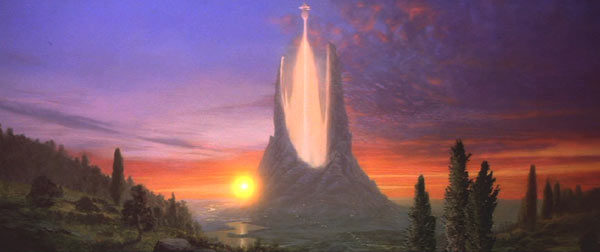
Oh, and the picture at the top is from The Neverending Story. You have read it, haven't you?

3 comments:
Yay! For Blogging w/o obligation! Teehee!
Yes, I am pretty sure B&N is the American equivalent, and yup, you described that section perfectly! :P
Honestly, I can't see what all the hype is about Harry Potter either. In my humble and un-asked for opinion, if the chief exorcist of Rome is warning people away from Potter... I wouldn't touch it with a mile long pole. I've also read that real witches (who do exist! Scary) praise the magic that is used in Potter. Another reason I cringe when I see the covers.
In order to help you answer your question [...]But what about in the world of books? Is it wrong to read or write about the "good guys" using magic?[...] you may find this article helpful.
http://www.decentfilms.com/sections/articles/magic.html
I completely agree with you, Rose. I can see how Harry Potter could attract a lot of people - Rowling is apparently able to spin a very engrossing tale - but that more contributes to the problem, in my opinion.
I will investigate the article you linked. before writing Art. 2. I have a feeling I'll be quoting "A Landscape With Dragons" by Michael O'Brien quite a bit. Thanks so much for commenting - I love it!
BTW, Rose, this is an unrelated question, but how do you configure yout blog so that you can change the ordinary bits of the template? For instance, on your blog, you have changed the 'comments' hyperlink to read '2 rose petals' and the like. How does one do that sort of thing?
Post a Comment